Custom baseball shirts for teams, dealers and brands: 3/4 sleeve raglan tees, practice shirts and team tees for families. We set where the contrast sleeve stops on every size, youth to 2XL. From 10 pieces per design, sample before bulk.
DESCRIPTION
Custom baseball shirts are the pieces a program orders most often and thinks about least: the three-quarter raglan tee in the bleachers, the practice shirt under a batting helmet, the team tee a whole family wears to the ballpark. Velzyn Wear makes all three in Sialkot, Pakistan, for teams, team dealers and brands, starting at ten pieces per design, and you hold a finished sample before any bulk run begins.
These shirts fail quietly. The contrast sleeve ends at the wrist on a youth small and just past the elbow on a 2XL. The practice shirt turns gray and baggy by June. A white-sleeved tee gets worn under a pitcher’s jersey and the umpire sends him back to the dugout to change. None of it shows on a mock-up. All of it shows on a sample, if you know where to look.
What searchers mean by custom baseball shirts
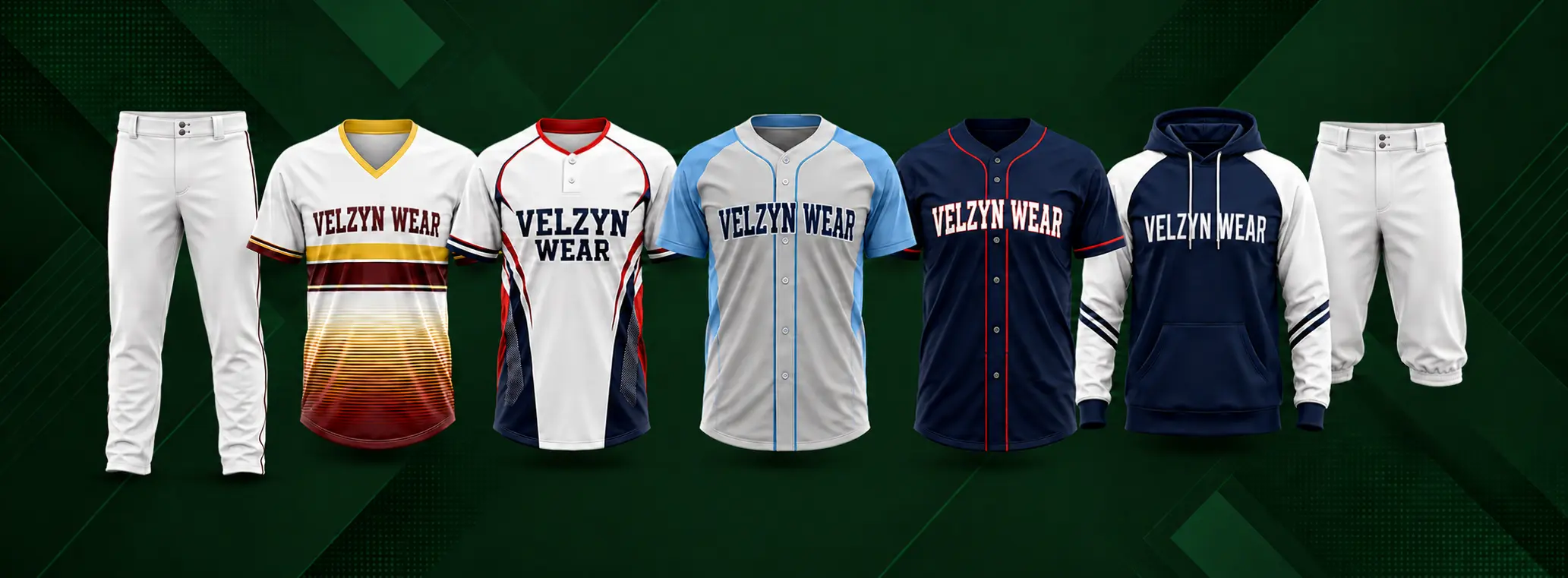
Search results for custom baseball shirts are led by custom baseball tees with a 3/4 raglan sleeve, then team t-shirts and baseball practice shirts. We make all three:
Raglan baseball tee
The classic 3/4 sleeve baseball tee.
- ✓Crew neck, contrast raglan sleeves
- ✓Three-quarter or short sleeve
- ✓Youth through adult in one run
Practice shirt
For the roster, Monday to Friday.
- ✓Short or long sleeve, performance polyester
- ✓Mesh back or side panels for heat
- ✓Number on the back so a coach can call a player
Team and fan shirt
For the stands and the car ride home.
- ✓Crew or V-neck tee with the team name
- ✓Mom, dad and grandparent versions
- ✓Sold through an online team store
A pullover with a two-button placket is a game jersey, covered on our custom two-button baseball jerseys page. The shirts here have plain crew or V necks.
Customizing your baseball t-shirts
- Sleeve and body colors: any combination, set from Pantone numbers or copied from your game uniform, with a strike-off when the shade has to match.
- Front: script, crest or full-chest graphic, sublimated; embroidery or a patch for texture.
- Back: names and numbers on practice shirts, a sponsor on fan tees.
- Sleeves and twill: a year or state flag on the contrast sleeve, or stitched tackle twill numbers so practice tops echo the game jersey.
- Private label: raglan tees for resale finished with your own woven neck label, tag and bag.
Fabric, shirt by shirt
| Shirt | Fabric we suggest | Why it suits the job |
|---|---|---|
| Raglan tee | Performance polyester, sublimated | Two-color sleeves that never crack or fade in the wash |
| Practice shirt | Polyester interlock, with mesh panels where heat builds up | Dries between drills and keeps its shape when soaked |
| Team and fan shirt | Polyester interlock | Prints edge to edge for big crests and numbers |
| Neck rib | A rib knit colored to your sleeve or body | Stops the collar rolling or stretching open |
Many retail baseball tees are cotton or tri-blend with a surface print, and a cotton-blend raglan can be quoted as an option for fashion lines. For team use we stay with polyester, since the print becomes part of the fiber. Fabric weight is fixed on your quote, then repeated on the tag clipped to your sample.
Men’s, youth and women’s cuts
Rosters are mostly boys and men, but half of all shirts are bought by people in the stands:
| Cut | What changes on the shirt | Who usually wears it |
|---|---|---|
| Men’s | Broad shoulder, straight body, longer back | High school and adult players, coaches, dads |
| Youth | Straight body, sleeve graded to a shorter arm | Little league and travel players |
| Women’s | Narrower shoulder, shaped side seams, shorter body | Moms and staff buying from the team store |
| Girls’ | Graded from the women’s shape for a younger frame | Players’ sisters, school spirit days |
If your team store sells to families, add the women’s cut. A boxy men’s medium gets worn once; the same design in a women’s shape gets worn every Saturday.
Where the three-quarter sleeve stops, on every size
On a raglan baseball tee the sleeve is the design. It is cut as one piece reaching from cuff to collar, so the contrast color runs from the neck to wherever the sleeve ends. Two measurements matter more than the chest print.
The end point. A three-quarter sleeve should stop a few inches above the wrist. Grade every size by the same step and the youth small reaches the wrist while the adult 2XL stops mid-forearm. We grade sleeve length to arm length, and on a sizing sample we show you the smallest and the largest size in your run so you can see both ends.
The diagonal. The raglan seam draws a line from the underarm to the collar. On a well-cut tee both lines sit at the same angle and meet the neck rib at the same point. Lay the sample flat, front up, and look at the two seams together: any twist shows at once.
A third check applies to sublimated shirts: sleeves and body are separate panels, so a navy sleeve can print a touch lighter than the navy chest logo. We print them in one run and compare them in daylight before sewing. Practice shirts just need a color that hides infield dirt, a number readable from the mound, and fabric that dries between drills.
Who buys baseball team shirts
| Coach or program | Parents and fans | Brand or team dealer | |
|---|---|---|---|
| Main shirt | Practice shirts, one or two per player | Raglan tees and team tees | Raglan tees in two or three colorways |
| What they need | Back numbers, a dirt-hiding color, fast spring reorders | Their player’s name and number, in their size | A retail-ready shirt under their own label |
| What goes wrong | Shirts that sag and fade by July | Sleeves that look wrong on their size | A second run that does not match the first |
Many programs run all three from one artwork file, with the store margin helping pay tournament fees. The design stays on file for next spring.
From roll to folded shirt: the fabric swatch strip
Each tee passes through six fabric states. A swatch from every state stays in your order file, which is how a reorder a year later comes out the same color:
Each swatch is kept with your spec card
1/6
Interlock or mesh arrives white and is opened on the table to look for holes and dropped stitches.
Pinned note: a faulty roll is set aside, not cut around
2/6
Your team colors printed on the real knit, to hold against a Pantone chip or last year’s shirt.
Pinned note: no shirt is printed until the strike-off is approved
3/6
Front and back printed flat, with artwork placed size by size rather than stretched from one file.
Pinned note: numbers sit at the same height on small and XL
4/6
Both sleeves come off the same print run as the body, so the contrast color holds across the order.
Pinned note: sleeve and body shade compared side by side in daylight
5/6
Collar rib cut and color-checked against the sleeve or the body, as your design asks.
Pinned note: rib stretches over the head and springs back flat
6/6
Raglan seams joined and hems finished; each shirt measured, matched to the roster and bagged.
Pinned note: sleeve end point measured against your signed-off sample
How to order baseball shirts
Pick the shirts
Raglan, practice or fan tee, and how many of each
Send artwork
Logo, colors, and the roster or store size list
Strike-off and sample
Color check first, then a sample shirt
Sign off, pay half
Bulk begins with the 50% deposit
Made and shipped
Checked, folded, bagged per player or family
Sizing and measuring
For practice shirts, measure the chest at its fullest point and pick the size on our baseball size chart; the hem should reach well below the belt. For raglan tees, add one number: from the center of the back neck, over the shoulder, to where the sleeve should stop on the arm. Other charts sit on our size reference page.
Blank tees or custom-made shirts?
| Blank tee, printed locally | Custom-made shirt | |
|---|---|---|
| Sleeve and body colors | Whatever two-tone combinations the blank maker stocks | Any pair of colors, matched to your uniform |
| Quantity | One shirt is fine | Ten per design, sizes mixed |
| Speed | Days, if the blanks are in stock | About five weeks until dispatch, then transit |
| Where it wins | A one-off event shirt next week | A program or label that sells the same shirt every year |
Washing baseball shirts
- Shake out infield dirt first; wet clay turns into a stain.
- Turn shirts inside out and wash in cold water with similar colors.
- No fabric softener and no bleach; softener coats performance polyester and slows drying.
- Hang dry or use a low dryer setting; heat is what shrinks the neck rib first.
Why programs and labels order shirts from Velzyn
Printed and sewn in our own building
- ✓Print, cut and sewing done in-house
- ✓No agent between you and production
Checked before the balance is due
- ✓Strike-off for color
- ✓A sizing sample when fit is uncertain
- ✓A finished shirt to approve before bulk
Sized for small programs
- ✓Ten shirts per design to start
- ✓Bulk 1–2 weeks after sign-off
- ✓Your own label, tag and bag
Rules that touch a baseball shirt
No uniform rule covers a practice or fan shirt. A shirt worn in a game is covered, and the pitcher’s sleeve is what trips teams up:
| When a shirt is worn in a game | High school (NFHS 2026, Rule 1-4) | College (NCAA 1-14) |
|---|---|---|
| Raglan tee under a pitcher’s jersey | Pitcher may not show white or gray undershirt sleeves, or any white or gray sleeve reaching past the elbow | Exposed undershirt parts one solid color, other than white |
| Tee used as the game top | Plain Arabic number on the back, at least 8″, one solid contrasting color; no duplicates | Back number at least 6″ |
| Sleeves | Left and right sleeve roughly equal on each player; none ragged, frayed or slit | Exposed sleeves the same solid color on every player |
| Maker’s logo | Maker’s mark capped at 2¼ square inches (2¼″ max each way); a 2×3″ US flag allowed per item | Check the current NCAA rules book |
So a white-sleeved raglan is fine in the stands, but not under a high school pitcher’s top. Rec leagues that play in tees set their own number sizes; send us yours.
Test the sample shirt yourself
- Sleeve line: lay the shirt flat and check that both raglan seams meet the collar at the same point.
- Collar: pull it over your head ten times, then lay it flat. The rib should lie down without a wave.
- Shade: hold a sleeve next to the chest logo by a window. The shared color should read as one.
- Wash once: measure body length before and after a cold wash. It should barely change.
What sets the price per shirt
- Shirt type: a practice tee costs less than a raglan with a separate contrast sleeve.
- Decoration: a sublimated design costs less than embroidery or stitched twill numbers.
- Extras: mesh panels and names on the back each add a little.
- Volume: each shirt costs less once the order passes 50, 100 and 250, and team store orders often reach those steps faster than the roster alone.
Order terms for custom baseball shirts
Ten shirts is enough to open a design, split across whatever sizes, names and numbers your list needs. Allow 7–10 days after artwork sign-off for the sample shirt. With that shirt signed off, bulk takes one to two weeks, and a typical team run lands near a week and a half. Payment is by bank transfer in two equal halves: one before cutting, one before the carton ships. For a sample ordered by itself, we accept Western Union and MoneyGram as well. Resellers who want shirts next to other products will find our terms on the wholesale manufacturing page.
Tell us which shirts you need, your colors, and whether they are for the roster, a team store or your own label.
Shirts sit inside our full custom baseball uniforms line. For colder days, pair them with custom baseball hoodies or custom baseball jackets, and for game day compare the four styles on our custom baseball jerseys page.
Custom baseball shirts: common questions
What is a raglan baseball tee?
A crew-neck shirt whose contrast sleeves reach up to the collar, usually cut three-quarter length. Most are sold today as team and fan wear.
Can a pitcher wear a raglan tee under his jersey?
In high school, only if the sleeves are not white or gray. NFHS rules bar white or gray exposed undershirt sleeves on a pitcher, so pick a dark sleeve color if pitchers will wear the tee under the uniform.
How many practice shirts does each player need?
Two is the usual number, so one is always clean. Teams practicing most days of the week often take three.
Can we sell the shirts through an online team store?
Yes. Send the size and name list when the store closes; we make one run and label a bag for each family.
Will the three-quarter sleeve look right on youth sizes?
It should, if the sleeve is graded to arm length. Ask for a sizing sample that includes your smallest youth size and check where the sleeve stops before approving the run.
